LEGIT99 Games and Pokies: Providers, Categories and Authenticity Risks
 Available in US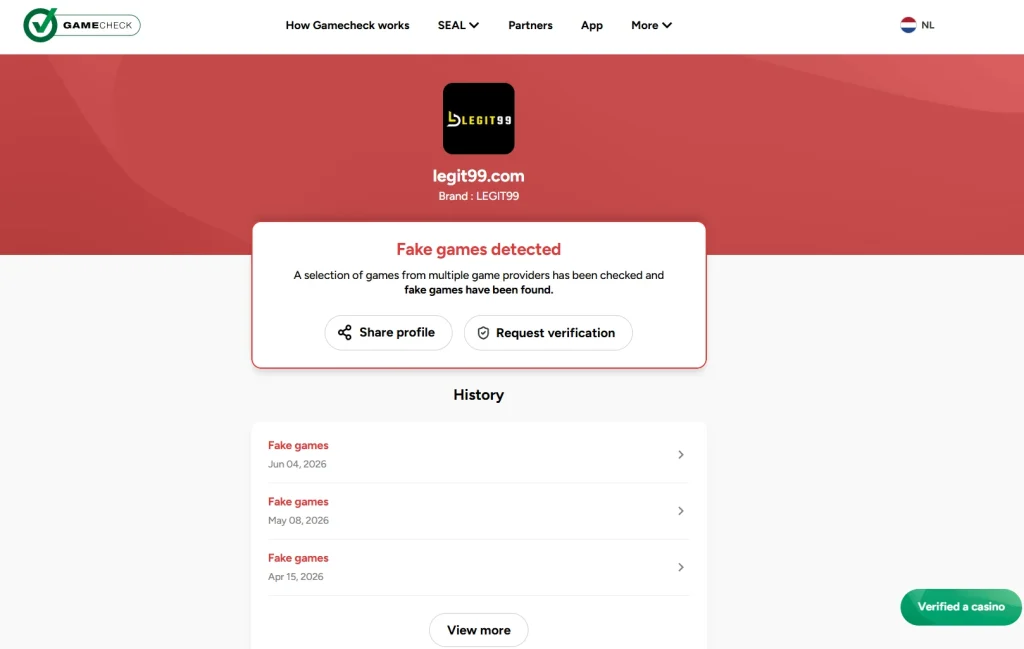
Game-library and integrity review
LEGIT99’s game catalogue is currently listed across independent review databases as drawing from 72 providers. Reported categories include slots or pokies, roulette, blackjack, betting-style games, video poker, bingo, baccarat, jackpots, keno, scratch cards and crash games. The higher-confidence structured sources used for this project currently record no live-dealer games. The most important finding, however, is not the size of the catalogue: Gamecheck records that randomised checks found fake games on legit99.com.
That authenticity warning is a serious integrity signal, but it does not prove that every game on the site is fake. This page therefore separates breadth from authenticity, avoids inventing individual titles or RTP figures, and gives Australian readers a practical framework for checking game provenance. For the overall risk assessment, see LEGIT99 safety.
Table of Contents
- What games are reported at LEGIT99?
- Pokies and slots: breadth is not the same as authenticity
- Current live-dealer status: treat it as a snapshot
- The decisive issue: Gamecheck reports fake games
- How to check whether a casino game looks authentic
- What the 72-provider number does and does not tell you
- How to interpret the main game categories
- Using the game library as part of a wider decision
- LEGIT99 games FAQ
- Recommend
What games are reported at LEGIT99?
The catalogue is broad on paper. Current structured sources list the following main categories: slots, roulette, blackjack, betting-style games, video poker, bingo, baccarat, jackpot games, keno, scratch cards and crash games. In Australian usage, “pokies” is a common everyday term for poker machines and slots, so this guide uses pokies naturally while retaining “slots” where it makes the category clearer.
The 72-provider figure describes breadth of supply, not a quality score. A large provider count can indicate variety in mechanics, themes and game formats, but it does not verify that every provider relationship is official, that every title is current, or that every game build is authentic. That distinction is especially important because of the separate Gamecheck finding discussed below.
| Question | Current finding | Evidence status |
|---|---|---|
| How many providers are listed? | 72 | Verified across independent structured sources |
| Are slots/pokies listed? | Yes | Verified |
| Are table-style categories listed? | Roulette, blackjack, baccarat and video poker are among the reported categories | Verified |
| Are crash games listed? | Yes | Verified |
| Are live-dealer games currently listed as available? | No in the higher-confidence structured sources used for this project | Current finding; recheck because lower-quality pages conflict |
| Is there an authenticity warning? | Yes – Gamecheck records fake games found in randomised checks | Verified high-risk integrity finding |
Pokies and slots: breadth is not the same as authenticity
For Australian readers, the pokies category is likely to be the most familiar part of the lobby. The verified category data supports the existence of slots/pokies, but this page deliberately avoids listing individual titles as recommendations. Individual game availability changes more quickly than category-level data, and the integrity warning means a title name alone is not enough to establish that the version being launched is the genuine provider build.
A useful catalogue review should therefore answer two separate questions. First: is the type of game you want present? Second: can the specific game instance be traced back to an authentic provider implementation? The first question can be answered from structured category data. The second requires provenance checks at the game level.
This is why a headline such as “72 providers” should not be converted into a claim that the library is automatically trustworthy. Provider breadth is a feature. Authenticity is an integrity property. They require different evidence.
Current live-dealer status: treat it as a snapshot
The higher-confidence independent databases reviewed for this guide currently record no live-dealer games at LEGIT99. Vegas Expert explicitly lists “No live games” and repeats that no games featuring a live dealer are available. A second structured review source supports the same conclusion.
Some lower-reliability affiliate pages claim live content exists. That conflict is exactly why this guide does not turn the current no-live finding into a permanent statement about the site. Lobby integrations can change, and affiliate pages can also copy or infer provider capabilities that are not actually enabled at a specific casino. The practical conclusion is narrower: the higher-confidence current sources say no live-dealer games.
If live casino access is a deciding factor, confirm the current lobby rather than relying on a provider name. A provider can supply both RNG and live products while a casino enables only part of that catalogue. For device and browser considerations, see LEGIT99 mobile.
The decisive issue: Gamecheck reports fake games
Gamecheck’s LEGIT99 profile is the key integrity source for this page. Gamecheck records that randomised checks found fake games on legit99.com. Casino Guru also surfaces the Gamecheck finding in its current review and warns that fake games were found in a selection checked across multiple providers.
The wording needs to stay precise. The finding supports the statement that fake games were detected. It does not support a claim that every title is fake, that every provider is affected, or that a specific game has a particular altered RTP. Those stronger claims would require game-by-game evidence that is not available in current sources.
Why does authenticity matter? A copied or modified game can look very similar to an original title while behaving differently from the provider’s intended build. It can also break the chain of accountability that normally lets a player identify the studio, game version and published help information. Even without assigning a numerical RTP change to any specific LEGIT99 title, the presence of detected fakes is enough to make provenance a central part of evaluating the library.
This finding should be read alongside the wider trust and integrity assessment, not treated as a substitute for it. Complaints, licensing evidence, payment behaviour and terms transparency are separate risk dimensions.
How to check whether a casino game looks authentic
No checklist can prove authenticity from appearance alone, but a structured check can identify reasons to stop and investigate further.
- Check the provider identity inside the game. Look for a clear studio name in the loading sequence, information panel or game rules. Do not rely only on a logo shown in the casino lobby.
- Inspect the launch path. Genuine integrations often load through provider or recognised platform infrastructure. An unfamiliar copy of a well-known interface on an unrelated host deserves extra scrutiny.
- Open the game information screen. Confirm that rules, paytable, version information and responsible-play controls are coherent. Missing or broken information is not proof of a fake, but it is a reason to avoid assuming the build is standard.
- Compare the interface with the provider’s own material. Layout, symbols and controls can change by version, so comparison is only a signal. Large unexplained differences should trigger a deeper check rather than a quick conclusion.
- Use an independent authenticity source when one exists. Gamecheck is relevant here because its warning is based on checks of game implementations rather than a generic review score.
- Do not infer authenticity from popularity. A familiar game name or well-known studio label is not sufficient when a source has already detected fake implementations on the same casino domain.
What the 72-provider number does and does not tell you
Provider count is useful for understanding catalogue shape. Seventy-two listed suppliers suggests that the lobby aggregates content from many sources rather than relying on a small in-house library. That can create more variety across slots, table-style RNG games, scratch cards and crash formats.
It does not tell you how many games are active, how many providers contribute only a handful of titles, which integrations are direct, or which builds passed an authenticity check. This guide therefore avoids listing provider names unless they are consistently supported and useful to the reader. A long studio list would add apparent detail without answering the more important integrity question.
The same principle applies to individual game titles, jackpots and RTP figures. Those facts are more volatile and more vulnerable to errors. This page stays at the category and provider-count level, where current independent sources agree, and uses the fake-games finding to explain why a catalogue count should not be read as a quality guarantee.
How to interpret the main game categories
The category list is more useful when it is read as a map of formats rather than a promise of depth. Slots or pokies are the core reel-based category. Roulette, blackjack and baccarat represent familiar table-style games, while video poker uses a draw-poker structure against a paytable rather than another player. Keno, bingo and scratch cards sit in a different rhythm, generally centred on number draws or instant-result mechanics. Crash games are faster multiplier-based formats where the timing of an exit is part of the basic interaction.
Those labels do not tell you how many titles exist inside each section, whether every game is available at all times, or whether the same provider mix is visible on desktop and mobile. They also do not establish authenticity. A useful browsing strategy is therefore to treat category presence as navigation information only, then verify the specific title before assigning weight to provider reputation or familiar branding.
The same caution applies to jackpots. Current sources support jackpot games as a category, but not any specific jackpot amount, network, probability or current title. Publishing a large prize figure without a current game-level source would turn a stable category fact into an unstable promotional claim. This guide intentionally stops at the category level.
For Australian readers, “pokies” and “slots” refer to the same broad reel-game category here. The local term makes the page sound natural, while “slots” remains useful when describing provider interfaces or international game classifications. Neither term changes the integrity checks required for the underlying game build.
Using the game library as part of a wider decision
For a conventional casino review, a large game list can be treated as a positive feature almost by default. LEGIT99 requires a different approach. The catalogue has reported breadth, but the authenticity warning changes the decision framework. Before evaluating theme choice, volatility or game variety, establish whether the game instance itself can be trusted.
That also affects how complaints should be interpreted. A complaint about a withdrawal is not evidence that a game was fake, and a fake-game finding is not proof about the outcome of an individual complaint. Keep those evidence streams separate. The LEGIT99 complaints page covers dispute records and their limitations.
For the same reason, this page does not assign an overall safety verdict based on games alone. The dedicated safety page combines game integrity with the rest of the risk evidence. The Australia review provides the site-wide overview.
LEGIT99 games FAQ
How many game providers does LEGIT99 have?
Current independent structured sources list 72 providers.
Does LEGIT99 have pokies?
Yes. Slots are part of the verified category set, and “pokies” is the natural Australian term used in this guide for that category.
Does LEGIT99 have live-dealer games?
The higher-confidence structured sources currently say no. Some lower-reliability pages conflict, so treat this as a current snapshot and recheck the live lobby if that category matters to you.
Are all LEGIT99 games fake?
No such claim is supported. Gamecheck records that fake games were found in randomised checks. That is serious, but it does not establish that every game is affected.
Can I rely on a provider logo to verify a game?
No. A lobby logo is only one signal. Check the game information screen, launch provenance and independent authenticity evidence where available.